⏰ Whenever





Typed and DST-safe datetimes for Python, available in Rust or pure Python.
Do you cross your fingers every time you work with Python’s datetime—hoping that you didn’t mix naive and aware? or that you avoided its other pitfalls? There’s no way to be sure…
✨ Until now! ✨
Whenever helps you write correct and type checked datetime code, using well-established concepts from modern libraries in other languages. It’s also way faster than other third-party libraries, and usually the standard library as well. Don’t buy the Rust hype?—don’t worry: a pure Python version is available as well.
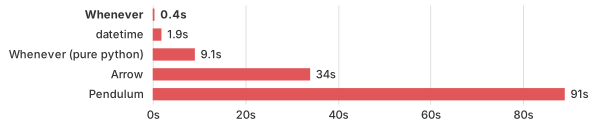
Parse, normalize, compare to now, shift, change timezone, and format (1M times)
⚠️ Note: Holding off on 1.0 a little longer so we can get the API just right for the long term—feedback (especially on durations) is still very welcome. Leave a ⭐️ on GitHub if you’d like to see how this project develops!
Why not the standard library?
Over 20+ years, Python’s datetime has grown
out of step with what you’d expect from a modern datetime library.
Two points stand out:
It doesn’t always account for Daylight Saving Time (DST). Here is a simple example:
bedtime = datetime(2023, 3, 25, 22, tzinfo=ZoneInfo("Europe/Paris"))
full_rest = bedtime + timedelta(hours=8)
# It returns 6am, but should be 7am—because we skipped an hour due to DST!
Note this isn’t a bug, but a design decision that DST is only considered when calculations involve two timezones. If you think this is surprising, you are not alone.
Typing can’t distinguish between naive and aware datetimes. Your code probably only works with one or the other, but there’s no way to enforce this in the type system!
# Does this expect naive or aware? Can't tell!
def schedule_meeting(at: datetime) -> None: ...
Why not other libraries?
There are two other popular third-party libraries, but they don’t (fully) address these issues. Here’s how they compare to whenever and the standard library:
Whenever |
datetime |
Arrow |
Pendulum |
|
|---|---|---|---|---|
DST-safe |
✅ |
❌ |
❌ |
⚠️ |
Typed aware/naive |
✅ |
❌ |
❌ |
❌ |
Fast |
✅ |
✅ |
❌ |
❌ |
Arrow
is probably the most historically popular 3rd party datetime library.
It attempts to provide a more “friendly” API than the standard library,
but doesn’t address the core issues:
it keeps the same footguns, and its decision to reduce the number
of types to just one (arrow.Arrow) means that it’s even harder
for typecheckers to catch mistakes.
Pendulum arrived on the scene in 2016, promising better DST-handling, as well as improved performance. However, it only fixes some DST-related pitfalls, and its performance has significantly degraded over time. Additionally, it’s in a long maintenance slump with only two releases in the last four years, while many serious and long-standing issues remain unaddressed.
Why use whenever?
🌐 DST-safe arithmetic
🛡️ Typesafe API prevents common bugs
✅ Fixes issues arrow/pendulum don’t
⚖️ Based on proven and familiar concepts
⚡️ Unmatched performance
💎 Thoroughly tested and documented
📆 Support for date arithmetic
⏱️ Nanosecond precision
🪃 Pydantic support (beta)
🦀 Rust!—but with a pure-Python option
🧵 Free-threading support (beta)
🚀 Supports per-interpreter GIL
Quickstart
>>> from whenever import (
...    # Explicit types for different use cases
...    Instant,
...    ZonedDateTime,
...    PlainDateTime,
... )

# Identify moments in time, without timezone/calendar complexity
>>> now = Instant.now()
Instant("2024-07-04 10:36:56Z")

# Simple, explicit conversions
>>> now.to_tz("Europe/Paris")
ZonedDateTime("2024-07-04 12:36:56+02:00[Europe/Paris]")

# A 'naive' datetime can't accidentally mix with other types.
# You need to explicitly convert it and handle ambiguity.
>>> party_invite = PlainDateTime("2023-10-28 22:00")
>>> party_invite.add(hours=6)
  TimeZoneUnawareArithmeticWarning: Adjusting a local time ignores DST [...]
PlainDateTime("2023-10-29 04:00")
>>> party_starts = party_invite.assume_tz("Europe/Amsterdam")
ZonedDateTime("2023-10-28 22:00:00+02:00[Europe/Amsterdam]")

# DST-safe arithmetic
>>> party_starts.add(hours=6)
ZonedDateTime("2023-10-29 03:00:00+01:00[Europe/Amsterdam]")

# Comparison and equality
>>> now > party_starts
True

# Rounding and truncation
>>> now.round("minute", increment=15)
Instant("2024-07-04 10:30:00Z")

# Formatting & parsing common formats (ISO8601, RFC3339, RFC2822)
>>> now.format_rfc2822()
"Thu, 04 Jul 2024 10:36:56 GMT"
# Custom pattern formatting and parsing
>>> party_starts.format("MMM DD, hh:mm zz")
"Oct 28, 22:00 CEST"

# If you must: you can convert to/from the standard lib
>>> now.to_stdlib()
datetime.datetime(2024, 7, 4, 10, 36, 56, tzinfo=datetime.timezone.utc)
Read more in the feature overview or API reference.
Limitations
Supports the proleptic Gregorian calendar between 1 and 9999 AD
Timezone offsets are limited to whole seconds (consistent with IANA TZ DB)
No support for leap seconds (consistent with industry standards and other modern libraries)
Versioning and compatibility policy
Whenever follows semantic versioning. Until the 1.0 version, the API may change with minor releases. Breaking changes will be meticulously explained in the changelog. Since the API is fully typed, your typechecker and/or IDE will help you adjust to any API changes.
License
Whenever is licensed under the MIT License. The binary wheels contain Rust dependencies which are licensed under similarly permissive licenses (MIT, Apache-2.0, and others). For more details, see the licenses included in the distribution.
Acknowledgements
Whenever draws from decades of datetime library design across multiple languages:
Noda Time and Joda Time pioneered the concept-per-type approach that makes whenever possible. Noda Time’s type hierarchy directly inspired whenever’s design.
Temporal (JavaScript proposal) provided inspiration for handling complex cases around DST ambiguity and rounding. After years of TC39 design work, Temporal’s API is extraordinarily thorough. Whenever benefits from those hard-won insights.
Python’s
datetimemodule is used extensively in whenever’s pure-Python implementation for low-level date/time handling.Whenever also borrows a few nifty ideas from Jiff: A modern datetime library in Rust which takes inspiration from Temporal.
The benchmark comparison graph is adapted from the Ruff project.